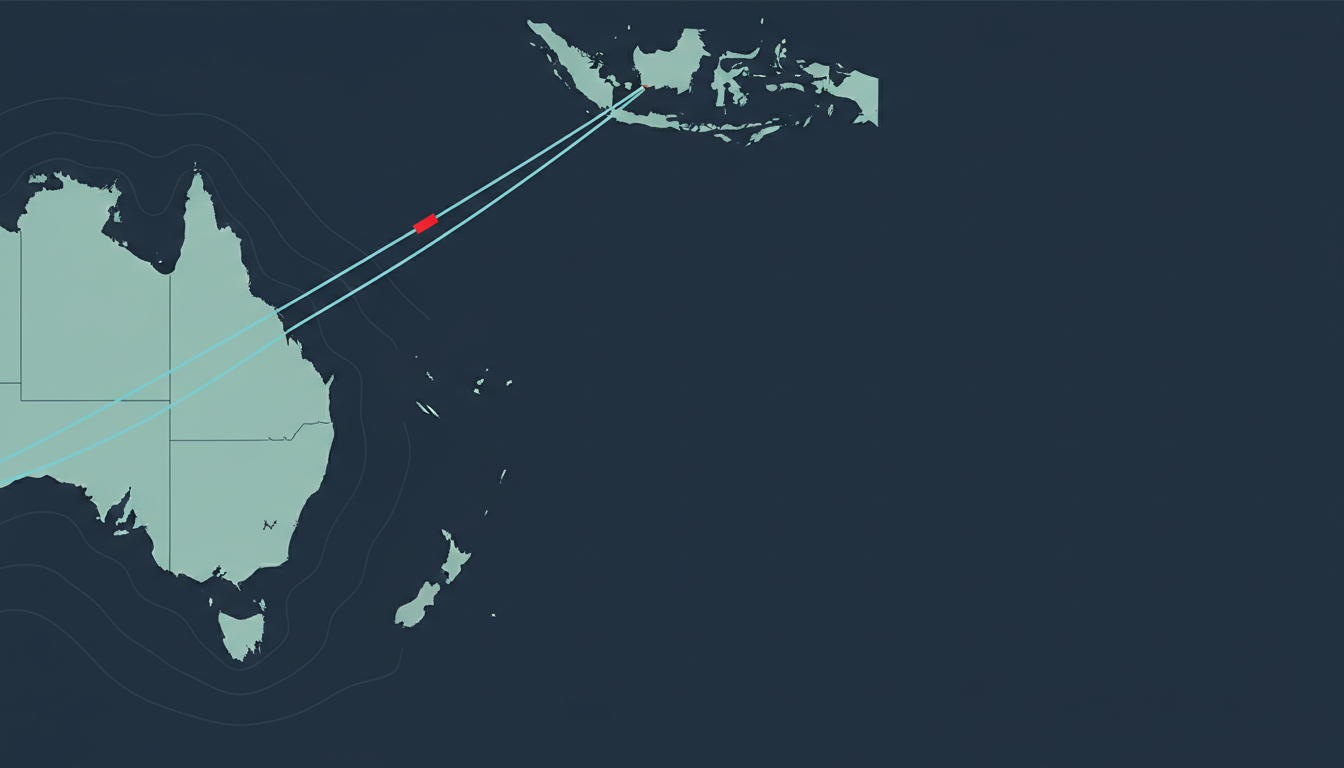
Two of the main data routes between Perth and Singapore are broken right now. As of the latest public statements, nobody has said why. That gap, between “cable down” and “cable cut on purpose,” is the whole lesson of undersea cables.
What happened
Over the weekend of August 8-9, two cables off Perth, INDIGO West and INDIGO Central, reported shunt faults in close succession inside the federally declared Perth cable protection zone. SUBCO’s co-founder, Bevan Slattery, called the timing concerning and raised “suspicious or coincidental” vessel activity. The Australian Federal Police said it had received a report of crime and was assessing it.
Then, on September 4, the Vocus Australia Singapore Cable broke in Indonesian waters between Anyer and Singapore. Vocus later placed the break about 615 km from the Singapore landing station. One trade outlet estimated the two Perth-Singapore failures together impaired up to 100 Tbps, and its own test showed Melbourne-to-Singapore traffic detouring through California and Tokyo, with round-trip times of 258 to 350 milliseconds. That is an outlet’s estimate and a single test, not an official figure.
As of Vocus’s September 25 update, the target is INDIGO West back around October 24 and the Australia Singapore Cable by November 4. Both dates depend on Indonesian permits and operating conditions.
What nobody has established
The cause. Vocus calls its break a fault and gives no cause. The reporting that links the two events does so by timing only; one report states that nothing on the record connects them and that Vocus has made no attribution. On the INDIGO systems, the trade press notes there is no fibre-sensing monitoring installed, so the physical cause may stay unknown until the damaged sections are pulled up and inspected.
This is a claim versus assessment problem. “Suspicious vessel activity” is a claim from a cable owner. “The AFP is assessing a report” is a process step, not a finding. Read the claim against the milestone: the milestone here is a recovered cable section and a published finding.
Our position, and the best case against it
Division 6 reads this first as a resilience story and only second as an attribution story. The evidence for that is structural. An ANU security analyst told ABC that Australia has 16 subsea cables carrying 99 per cent of its international communications, that no single agency is responsible for protecting them, and that the government has limited power over privately run cables. The 99 per cent figure is widely repeated; TeleGeography says it can confirm the claim is true but cannot calculate it precisely without satellite traffic data. Treat it as a rough scale, not a decimal.
The Baltic shows why jumping to sabotage is risky. In January 2025, one Sweden-Latvia cable break first drew sabotage suspicion that was later dropped as an accident, according to that incident log. Wikipedia is a secondary source, so treat it as a pointer.
The best opposing view is serious. Two faults in close succession, in the same protected zone, with a vessel nearby, is exactly the pattern a sabotage planner would also produce, and waiting for proof is how states get caught flat. The same log lists repeated Baltic cable incidents from November 2024 to December 2025, several still marked as under investigation. That is a fair argument for investigating hard, and the AFP assessment is the right first step. What it does not justify is naming a culprit before there is a finding.
Why it matters beyond Australia
Cables are a chokepoint like any strait. The difference is that a break cannot be cleared quickly: traffic reroutes until a repair ship reaches the site, and the Vocus plan above puts that at weeks. Perth-Singapore is a corridor, and when it narrows, traffic takes the long way across the Pacific. Even a pure accident shows how few spare routes exist.
What to watch
- Whether INDIGO West is restored around October 24 and the Australia Singapore Cable by November 4, or whether the dates slip.
- Whether recovered cable sections produce a published cause.
- Whether the AFP says anything beyond “assessing.”
- Whether Canberra names a lead agency for cable protection.
Sources
- Converge Digest, SUBCO Reports Dual INDIGO Shunt Faults Near Perth
- ABC News, Two subsea communication cables damaged off Perth coast in ‘concerning development’
- AUNS, Second Perth-Singapore cable fails, traffic via US
- Tech Business News, Vocus Australia-Singapore Cable Break Leaves International Traffic On Longer Routes
- Vocus, Update on repairs to the Australia Singapore Cable
- TeleGeography, Do Submarine Cables Account For Over 99% of Intercontinental Data Traffic?
- Wikipedia, Baltic Sea underwater infrastructure incidents
Facts last verified: Saturday, October 17, 2026, 5:55 AM Pacific
Leave a Reply