Update, November 4, 4:23 AM Pacific (12:23 UTC): The Philippine Star reported today, citing diplomatic sources rather than an official Chinese announcement, that Xi Jinping will skip the ASEAN summit in Manila on Nov. 16-18. Premier Li Qiang may go instead, though arrangements are not final. That partly answers the question about China’s delegation raised near the end of this piece, and it makes a leader-level thaw less likely. The article’s central point still holds: the contest is over presence and coercion below the treaty line, and the summit is still a test of whether any binding rules emerge.
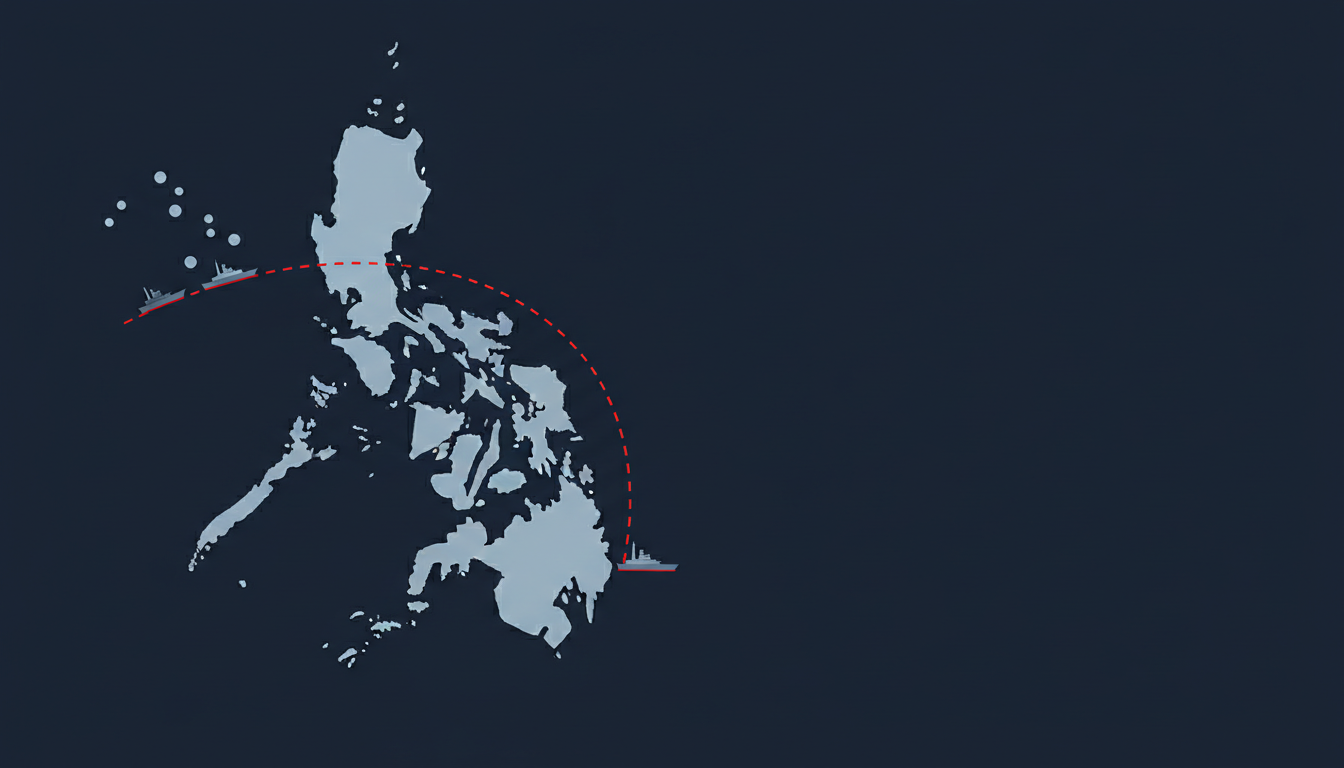
The Philippines is the one place in Asia where a US treaty ally and China meet at sea almost every week. The pressure there is changing shape. It is moving from dramatic collisions to something harder to photograph: more ships, more patrols, and fewer clean tests of the treaty.
What changed in September and October
Manila said its military counted 101 Chinese navy and coast guard ships around Philippine-held and contested features in September, nearly double the 56 it logged the month before. The count covered Thitu Island, Second Thomas Shoal, Sabina Shoal and Scarborough Shoal. A Philippine military spokesman, Rear Adm. Roy Vincent Trinidad, described the buildup as an attempt to wear down Filipino resolve. Note the source: it is a Philippine tally, and Manila is a party to the dispute.
The ships are not just sitting there. In late September, Chinese navy and coast guard vessels blocked a resupply run to the grounded BRP Sierra Madre at Second Thomas Shoal, and Manila turned the mission back for safety after a radio warning. The US ambassador in Manila condemned the blocking. A month later, China’s coast guard said it had monitored another Philippine delivery to the shoal on Oct. 21. The report did not say whether that delivery was completed or stopped. On Oct. 19, Manila had summoned China’s ambassador over remarks it said conveyed a threat of force.
Then the pressure moved to Scarborough Shoal. On Oct. 27, a Philippine fisheries vessel delivered fuel to fishermen there, with Chinese coast guard and navy ships watching from the approaches. The Philippine Coast Guard said it passed without incident. A similar mission in July drew water cannon. On Oct. 30, the People’s Liberation Army’s Southern Theater Command announced combat readiness patrols around the shoal, which Reuters reported alongside separate coast guard patrols. Neither said which Philippine actions they were answering.
The treaty question
Washington’s position is public. In October 2025, a State Department spokesman said Article IV of the 1951 treaty covers armed attacks on Philippine armed forces, public vessels or aircraft, including the Coast Guard, anywhere in the South China Sea. The operative words are “armed attack.”
Here is the Division 6 position, and it is our reading, not an official one. Almost everything in the list above sits below that line. Shadowing, blocking, monitoring and patrolling are coercion without shooting. A larger Chinese presence lets Beijing raise the cost of Philippine operations without ever giving Washington a clear trigger. That is the signal in the ship count: the contest is over who can operate normally, not over who fires first.
The best case against this reading
Two things argue for calm. First, the Oct. 27 fuel mission and the Oct. 21 resupply both appear to have gone ahead without a public confrontation, so Beijing may be calibrating rather than escalating. Second, one month of counts from one side is a thin basis for a trend. If October’s numbers fall back toward August’s, the “surge” was a spike. We are watching for that.
The Taiwan link
The Philippines also matters because of geography to its north. In May, US and Philippine forces showed a US anti-ship missile launcher in Batanes, about 100 miles south of Taiwan, during exercises. The Philippine exercise director called it a rehearsal that would be withdrawn afterward. Remember the Taiwan Strait piece we ran on Oct. 21: if the squeeze there is coast guard, not warships, this is the same toolkit applied to a different neighbor.
Rules of the road: still unwritten
Manila chairs ASEAN this year and wanted a South China Sea code of conduct text by July. Analysts at Asialink called that deadline more rhetorical than substantive, with disputes over legal force and outside powers’ drills unresolved. Chatham House made a similar case last December. We could not confirm that any text has been concluded. Read any announcement against whether it is binding and whether China agreed to it.
The next test is close. The ASEAN summit and related meetings open in Manila on Nov. 16, running through Nov. 18. On Nov. 3, a Palace spokesperson said it would be better if China’s leadership attended, to talk through the rifts. Philstar reported that Beijing has not said who will lead its delegation and usually sends its premier. It also noted that Xi is due to host APEC leaders in Shenzhen on Nov. 18 and 19, which overlaps the summit’s last day.
What to watch
- October’s ship count from the Philippine military, against September’s 101.
- Whether Second Thomas resupply runs reach the Sierra Madre, and whether Manila says so publicly.
- Any US statement that names a specific incident, not just the treaty in general.
- Whether the PLA patrols at Scarborough become routine.
- Who China sends to Manila on Nov. 16-18, and whether a code of conduct is binding, with China’s name on it.
Sources
- AFP via Malay Mail, Chinese vessels surge around Philippine-held outposts in South China Sea (Oct. 8, 2026)
- Indo-Pacific Defense Forum via Eurasia Review, Philippines, U.S. Condemn China’s Dangerous Tactics at Second Thomas Shoal (Oct. 12, 2026)
- Reuters via The Star, China’s coast guard monitors the Philippines resupplying vessel at disputed shoal (Oct. 22, 2026)
- Philstar.com, Chinese ships seen near PH fuel distribution to fishermen at Scarborough Shoal — PCG (Oct. 28, 2026)
- Reuters via Baird Maritime, China ratchets up tensions with patrols around disputed shoal in South China Sea (Oct. 30, 2026)
- Manila Bulletin, US reaffirms defense support for PH after sea clash with China near Pag-asa (Oct. 14, 2025)
- Reuters via The Star, US and Philippines deploy anti-ship missile system in Batanes near Taiwan for war games (May 2, 2026)
- Asialink, University of Melbourne, Between talks and tensions: why the South China Sea won’t stabilise in 2026 (June 3, 2026)
- Chatham House, With the Philippines as ASEAN chair, a South China Sea agreement is unlikely to be concluded in 2026 (Dec. 9, 2025)
- Philstar.com, Could Xi come to Manila? Palace says visit could help settle tension (Nov. 3, 2026)
- Philstar.com, China’s Xi skipping Asean meet; Palace hopeful (Nov. 4, 2026)
Facts last verified: November 4, 2026, 4:23 AM Pacific (12:23 UTC)
Leave a Reply