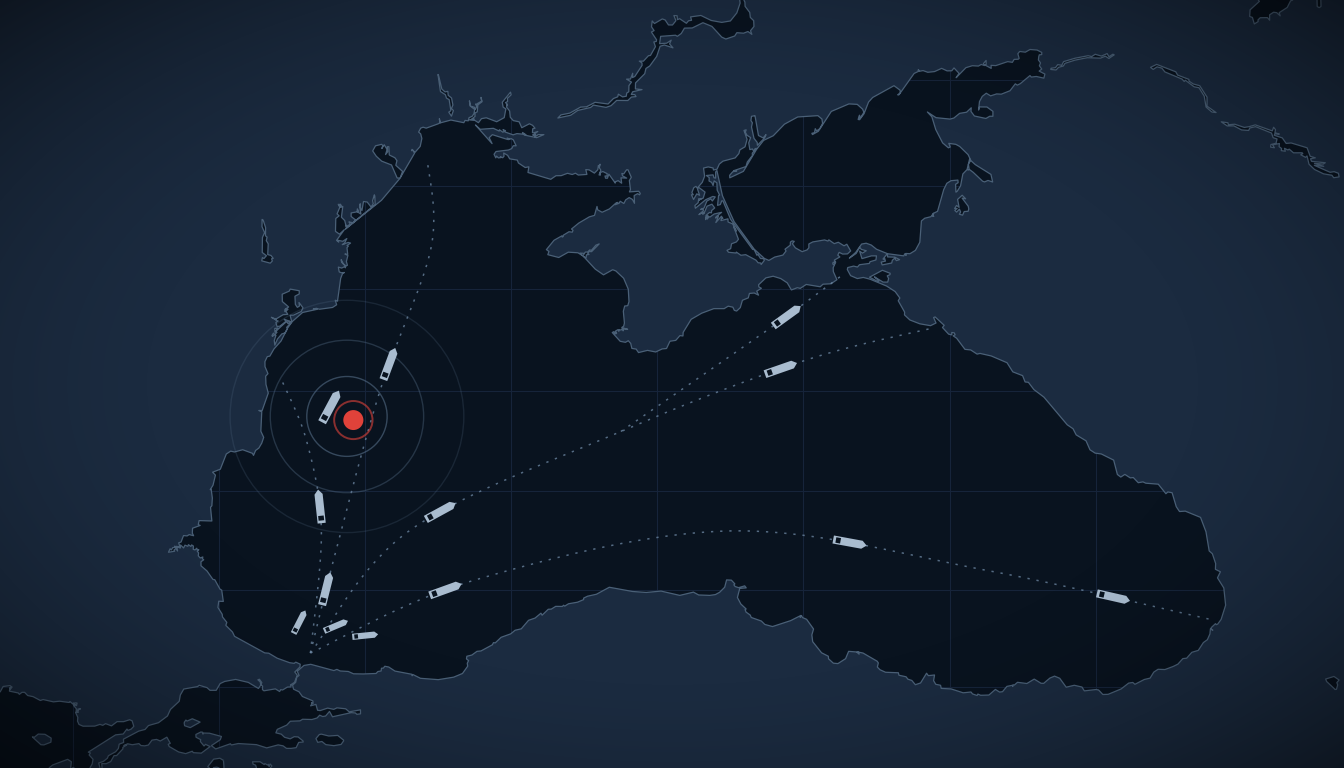
Update, November 1, 4:25 AM Pacific (12:25 UTC): The container ship Contship Jet, described below as badly damaged and listing after the October 28 drone strike, has since sunk, according to Türkiye Today, citing the local maritime administration. All 18 crew were rescued, and no one has claimed the attack. Bulgaria’s defense minister said the drones did not enter its territorial waters and that the country is “not at war.” That is another hull lost inside the zone this piece is about, and it leaves the argument unchanged.
In early October this post was going to be about one burning tanker. On October 6 the Liberia-flagged crude tanker Aframax Rio caught fire off Sochi after what Russia’s Transport Ministry called an attack by unmanned boats. All 23 crew, Indian nationals, were rescued. The next evening President Volodymyr Zelensky said Ukraine’s military had hit a tanker in the Black Sea, without naming it. Ukraine had put the ship on its shadow-fleet sanctions list in February.
That is still half the story. The other half has grown much faster, and it is happening off the coasts of two NATO members.
What changed in October
The day before the Sochi fire, the grain ship Royad Mammadov, carrying corn from the Ukrainian Danube port of Izmail, caught fire and sank outside Romania’s territorial waters. Two crew died and 11 were rescued; Zelensky blamed two Russian drones. On October 6 drones hit two ships in Bulgaria’s exclusive economic zone. The Togo-flagged Alfa Watan sank about 70 nautical miles off the coast. Its 10 crew, nine Syrians and one Egyptian, were never found, and Bulgaria ended the search the next day. The Palau-flagged Able, carrying wheat, burned; its 18 crew were evacuated.
It kept going. About a week later the Guinea-Bissau-flagged HS Dignity sank about 17 nautical miles east of Shabla, and the Malta-flagged Chelsea 3 was damaged off Byala, AP reported. On October 15 two chemical tankers anchored near the mouth of Romania’s Sulina Canal, the Wine Trader and the Yara J, caught fire. Seven of the 12 people on the Wine Trader were missing. Romanian President Nicușor Dan put it plainly: “Two drones hit them.” On October 23 the Comoros-flagged cargo ship Khoryv, bound for Sulina, caught fire and capsized about 13 nautical miles east of Constanța, with one dead and three missing. Authorities did not give a cause.
Then on Wednesday, October 28, three naval drones hit the Liberian-flagged container ship Contship Jet about 21 nautical miles southeast of Shabla, on its way from Haifa to Constanța. All 18 crew, 14 Filipinos and four Ukrainians, were rescued. A maritime security source told Reuters the ship was badly damaged and listing.
The casualty count depends on who is counting. AP’s tally for this month’s attacks in the two countries’ economic zones is two dead and at least 25 missing. Reuters, working from government statements on missing crew, says the attacks off Bulgaria have likely killed some two dozen seafarers. Treat both as provisional.
Who is doing it
Nobody has proved it in public. NATO, Bulgaria and Romania have not formally attributed the attacks, and Moscow denies involvement. But the officials closest to them lean one way. Bulgarian Prime Minister Rumen Radev, who summoned Russia’s ambassador after the mid-October hits, said: “We don’t believe that Ukraine will attack its own ships and crews… However, we don’t have any solid evidence that the drones are Russian.” EU foreign policy chief Kaja Kallas called it “six attacks in 10 days by suspected Russian drones.” And the Financial Times, citing the security firm Ambrey, reported that Russia was responsible for about 90% of attacks on shipping over the past 45 days.
So the war at sea still runs both ways. It does not run evenly. Ukraine’s campaign aims at Russian oil revenue: tankers like the Aframax Rio and the ports that load them. This month’s pattern hits ships on routes tied to Ukraine’s trade. The Royad Mammadov sailed from Izmail. The Khoryv was heading for the Danube’s mouth with 10 Ukrainians among its 13 crew. And the hits are landing in EU and NATO waters.
What it costs
The FT, citing Ambrey and the International Maritime Organization, counts more than 570 vessels attacked in the Black Sea this year and at least 40 seafarers killed, with about 387 attacks in the third quarter alone. It reported that war-risk cover can reach 15% of a ship’s value. Lukoil’s commercial manager in Bulgaria, Evgeni Simeonov, told Bulgarian television that insuring an oil tanker for the crossing went from about $200,000 to $2.5 million per vessel in recent months. That is one executive’s figure, not a market index, so read it as a direction, not a rate card.
Ukraine’s side is worse. Port operator TIS said Greater Odesa handled fewer than 10 ships in September, against about 400 in July, and Ukraine’s agriculture ministry said seaborne farm exports fell to 1.4 million tonnes in August, about 75% below pre-war levels, according to the same FT reporting.
What it means for you
If you buy fuel, food shipped through Black Sea routes, or pay premiums tied to marine war risk, treat the Black Sea as a third choke alongside the Gulf and the Red Sea. Different actors, same transmission into delivered prices. A grain corridor running at a trickle and insurance quotes in the millions are costs that show up downstream, even when every crew is rescued and every fire goes out.
Where Division 6 lands
Our read: the Black Sea is no longer a war zone with a shipping problem. It is a NATO problem with a war attached. The attacks moved from the front line into the economic zones of two alliance members, and the alliance has answered with sensors, not ships. On October 20 NATO said allies would send more maritime patrol aircraft, radar, explosives teams, intelligence staff and drones. Its spokesman said “the most important thing” was to increase situational awareness. On October 28 the defence ministers of Bulgaria, Romania and Turkey met in Sofia and agreed on more intelligence sharing and early warning. Watching is not the same as stopping.
The best opposing view is fair. The ships hit are mostly smaller cargo ships and chemical tankers under flags of convenience, not the big crude carriers that set world oil prices, and Bulgaria’s Burgas refinery has reportedly secured supply into early December. Better surveillance and forensic analysis of the explosives could raise the cost of deniability enough to slow the attacks. Turkey, which controls the exit through the Bosporus, has warned both Russia and Ukraine and says it reserves the right to take legal action. If that pressure works, the premium eases. We are not betting on it before attribution is public.
What to watch
- Whether NATO’s explosives teams produce a public attribution, and whether Sofia or Bucharest act on it.
- Whether anyone moves from surveillance to escorts. Nothing announced so far does.
- Greater Odesa and Danube traffic for October against September’s fewer than 10 ships.
- Any new Ukrainian strike on a Russian tanker or export port, and what follows at sea.
- Turkey: whether “legal action” turns into anything at the Bosporus.
Sources
- ABC News, Tanker attack in Black Sea off Sochi sparks ‘fire of oil’, Russia says (Oct. 7, 2026)
- Baird Maritime, Tanker catches fire following suspected drone strike in Black Sea off Russia (Oct. 7, 2026)
- Kyiv Post, Shadow Tanker Hit by Ukrainian Drones Threatens Spill Off Russia’s Black Sea Coast (Oct. 8, 2026)
- Reuters via KSL, Romania says two dead after fire on ship, Ukraine blames Russian drones (Oct. 5, 2026)
- Al Jazeera, Bulgaria searches for missing crew after drones hit two ships in Black Sea (Oct. 6, 2026)
- The National, Nine Syrians missing after cargo ship sunk by drone in Black Sea (Oct. 8, 2026)
- OilPrice.com, Black Sea Oil Shipping Insurance Costs Surge to $2.5 Million (Oct. 12, 2026)
- Al Jazeera, Seven missing after two tankers catch fire off Romania’s Black Sea coast (Oct. 15, 2026)
- Al Jazeera, NATO to send additional patrol planes to Black Sea after drone attacks (Oct. 20, 2026)
- Maritime Executive, NATO to Support Increased Black Sea Surveillance (Oct. 21, 2026)
- AP via CP24, Romania says rescue mission underway after Black Sea ship fire; 1 dead, 3 missing (Oct. 23, 2026)
- LIGA.net, FT: The Black Sea has become the deadliest route in the world for merchant vessels (Oct. 25, 2026; summarizes Financial Times reporting citing Ambrey and the IMO)
- Reuters via gCaptain, Drones Hit Container Ship off Bulgaria, Crew Safe and Ashore (Oct. 28, 2026)
- AP via ABC News, Drones strike a container ship off Bulgaria’s Black Sea coast and its crew members are rescued (Oct. 28, 2026)
- Türkiye Today, Drone-hit container ship sinks off Bulgaria in latest Black Sea attack (Oct. 29, 2026)
Facts last verified: November 1, 2026, 4:25 AM Pacific (12:25 UTC)
Leave a Reply